
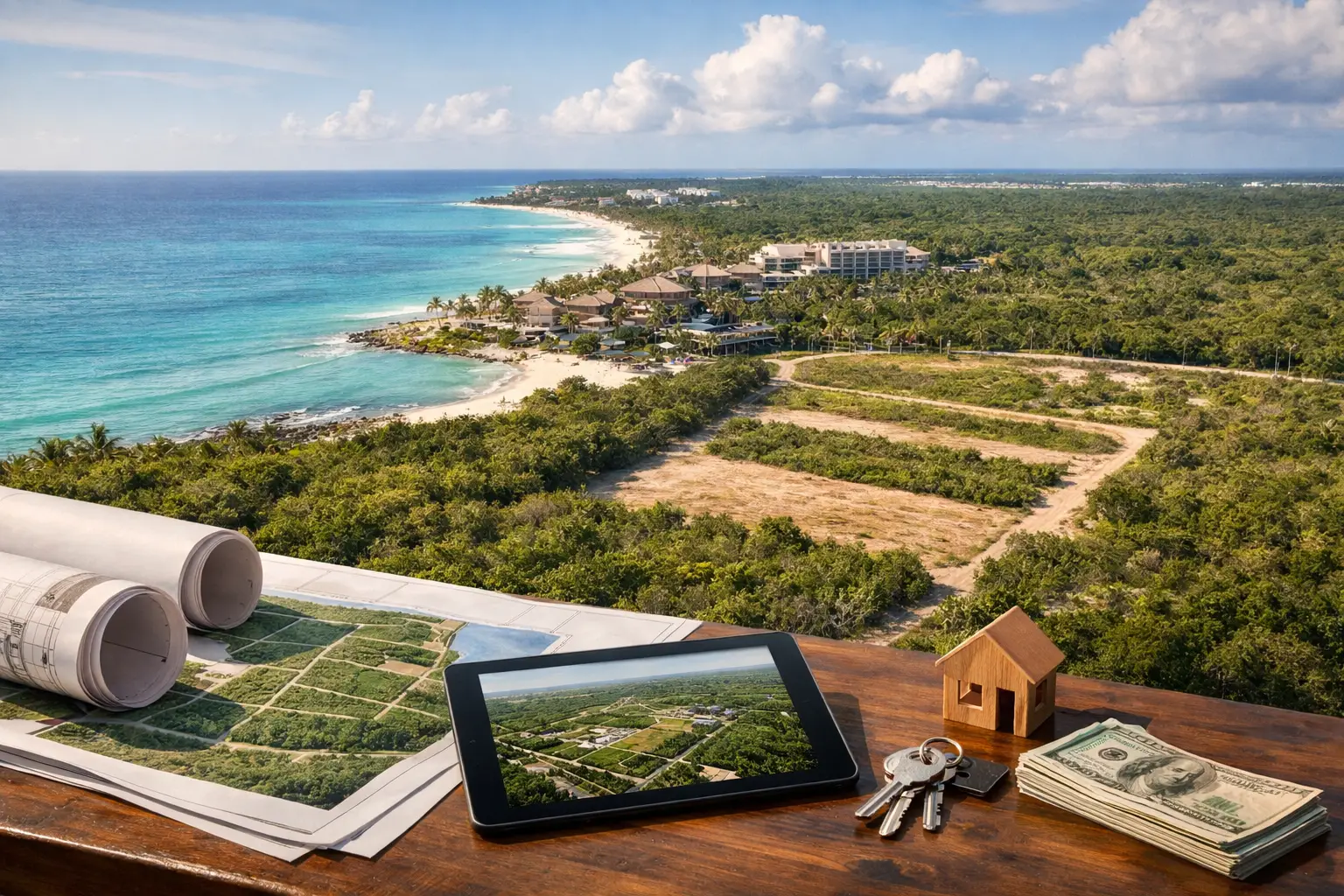
You can renovate a condo over a long weekend. Land, on the other hand, is famously incapable of sending you a rental check while it waits. That is precisely why a land banking returns case study needs to be judged differently from a vacation-rental investment. Your return comes from patient positioning: acquiring well-located land before infrastructure, population growth, and development demand are fully priced in.
For foreign investors considering Quintana Roo, land banking can be a compelling complement to income-producing real estate. It is not a shortcut, and it is not a guaranteed win. It is a longer-horizon strategy for investors who want exposure to the growth of the Riviera Maya corridor without assuming that every parcel will become the next major development.
What Land Banking Actually Means
Land banking is the acquisition and controlled holding of land with the expectation that its value will rise as the surrounding area matures. The investment thesis may be tied to a growing urban boundary, a new road connection, utility expansion, tourism demand, or future residential and mixed-use development.
Unlike buying a completed condo in Playa del Carmen, land banking generally produces no immediate rental income. In exchange, you may enter earlier in the value cycle and avoid some of the operational demands of furnishing, marketing, and managing short-term rentals.
The trade-off is clear. A condo can offer potential cash flow but requires active oversight and has operating costs. Land is simpler to hold, yet its value realization depends on timing, legal clarity, and a credible path to future demand. Your capital may be tied up for years.
Land Banking Returns Case Study: A Modeled Example
Consider an anonymized, illustrative acquisition in a growth area between established Riviera Maya destinations and emerging residential zones. This is a modeled scenario based on the type of underwriting an investor should request, not a promise of future performance.
An investor group acquires a properly titled parcel intended for future low-density residential development. The group chooses land outside the immediate resort core, where entry costs are lower but development momentum is visible. Before closing, the team verifies access, land-use designations, title history, environmental considerations, and the feasibility of utilities.
The holding period is six years. During that time, nearby road improvements, new services, additional residential construction, and sustained visitor activity increase the area’s relevance to developers and end users. The group does not rely on a single headline or rumor. It monitors comparable land transactions, permits in the surrounding zone, infrastructure progress, and the number of active projects reaching delivery.
Here is how the investment logic could look:
| Metric | Illustrative Scenario | | — | — | | Holding period | 6 years | | Income during hold | None assumed | | Value drivers | Road access, utilities, residential demand, nearby development | | Exit options | Sell the land, sell to a developer, contribute to a joint venture | | Return measure | Net equity gain after acquisition, holding, and disposition costs |
If the land’s market value rises steadily over the six-year hold, the headline appreciation number may look attractive. But the investor’s real return is lower after closing expenses, trust-related costs where applicable, legal review, property taxes, carrying costs, and sale expenses. That is why sophisticated investors model net proceeds, not just a future asking price.
For example, a parcel that appears to double in value has not necessarily doubled your invested capital. If total transaction and holding costs represent a meaningful share of the initial investment, your net result changes. The opposite can also be true: a carefully structured acquisition with a strong development exit can create value beyond a simple resale, particularly when landowners contribute land into a well-governed joint venture.
Why Joint Ventures Can Change the Outcome
A landowner does not always need to sell at the first attractive offer. In some cases, contributing land to a development venture may allow the owner to retain an equity interest in the finished project. This can increase potential upside, but it also introduces construction risk, timing risk, and dependence on the development partner.
A joint venture is not automatically better than a sale. It depends on your liquidity needs, appetite for risk, governance rights, and confidence in the project’s feasibility. Your agreement should clearly define ownership, capital obligations, decision-making authority, distributions, exit rights, and what happens if the project is delayed. This is a place for experienced Mexican legal counsel and a qualified notario, not handshake optimism.
The Riviera Maya Growth Case Must Be Specific
The Riviera Maya is not one market. Tulum, Playa del Carmen, Puerto Morelos, Cancún, and the communities between them respond to different demand drivers. A parcel near an established service corridor has a different risk profile than remote land that depends on future infrastructure.
One useful signal is air connectivity. Cancún International Airport processed roughly 30 million passengers in 2023, reinforcing the region’s role as a global tourism gateway. Tourism alone does not justify every land purchase, but it supports a wider ecosystem of hospitality, housing, services, retirement demand, and business formation.
Government infrastructure investment can also influence land values, although investors should separate announced projects from completed, usable improvements. Roads, stations, airports, utilities, and public services matter when they improve access and make development economically practical. The 2026 FIFA World Cup may increase international attention on Mexico, but smart land underwriting should never depend on a single event. Lasting value comes from year-round demand and functional infrastructure.
Investor Takeaway
The best land banking opportunity is rarely the cheapest land. It is the parcel with the clearest chain from today’s use to tomorrow’s demand. You are buying a position in a future neighborhood, not merely a set of coordinates on a sales map.
How to Measure a Land Banking Return Honestly
A disciplined analysis starts with a simple question: what must happen for this land to become more valuable? If the answer is only that someone else will pay more later, the thesis is incomplete.
You want measurable catalysts. These can include documented road access, utility plans, permitted nearby projects, a growing residential catchment, or a location within an expanding commercial and tourism corridor. Then you need to test whether the purchase price already reflects those catalysts.
Your return model should account for the purchase cost, legal and due-diligence expenses, annual carrying costs, potential fideicomiso costs for restricted-zone ownership, and expected exit costs. Foreigners can legally acquire property in Mexico, including within the restricted zone near the coast, commonly through a fideicomiso with a Mexican bank. The trust grants beneficial rights and is a standard ownership structure, but its costs and renewal terms belong in your underwriting.
Also compare land banking against your alternatives. A pre-sale condo may offer a more defined delivery path and potential rental income after completion. A stabilized rental property may provide cash flow sooner. Land can offer greater flexibility and potential appreciation, but it should fit the role you want it to play in your portfolio.
The Risks That Deserve Your Attention
Land banking becomes dangerous when marketing gets ahead of verification. Before committing capital, investigate these areas with professionals who represent your interests:
- Title history, ownership rights, liens, and the legal route for foreign ownership.
- Access rights, road conditions, and whether access is legally documented rather than merely visible.
- Zoning, density allowances, environmental restrictions, and the realistic ability to build.
- Water, electricity, drainage, and the true cost and timing of utility connections.
- The sponsor’s track record, if the opportunity involves a land subdivision, pooled investment, or future joint venture.
Do not confuse a master plan with an approved development. Ask what has been permitted, what remains conceptual, and who is responsible for funding each next step. A good advisory process does not make risk disappear. It makes risk visible before your funds are committed.
Is Land Banking Right for Your Wealth Plan?
Land banking can suit investors who already have liquidity, can hold through market cycles, and want geographic diversification beyond Canada or the United States. For some buyers, Mexico also offers a lifestyle advantage: a lower cost of living in parts of the Riviera Maya, proximity to North America, and a potential retirement base alongside an investment portfolio.
It may be less suitable if you need monthly income, cannot tolerate a delayed exit, or are unfamiliar with the legal and development process. In that case, a completed rental property or carefully selected pre-sale condominium may align better with your objectives.
Before choosing either path, take the Investor Readiness Scorecard. It is designed to help you clarify your timeline, risk tolerance, income goals, and the level of support you may need before purchasing abroad.
Frequently Asked Questions
Is land banking in Mexico legal for foreigners?
Yes. Foreigners can acquire beneficial rights to property in Mexico’s restricted zone through a fideicomiso, or bank trust. The exact structure depends on the property, location, and transaction. Work with a qualified notario and legal advisor to confirm the appropriate ownership route for your situation.
How long should I hold land in Riviera Maya?
Many land banking strategies require a multi-year horizon, often five years or longer. The right timeline depends on infrastructure progress, local demand, your purchase basis, and your preferred exit strategy. If you need short-term liquidity, land may not be the right asset.
Can land banking generate rental income?
Usually, undeveloped land produces no rental income. Some parcels can support parking, storage, agriculture, or temporary commercial uses, but those uses require separate legal, operational, and market analysis. Most investors should underwrite vacant land with zero income unless a permitted revenue source is already in place.
What is the biggest mistake land investors make?
Buying based on a low price without confirming title, access, zoning, and utilities. Cheap land can become expensive when the parcel cannot be used, financed, accessed, or sold as expected.
The Riviera Maya is still creating new residential and hospitality corridors, but the most understandable opportunities are rarely visible forever. If land banking belongs in your long-term plan, the practical next step is not rushing to reserve a parcel. It is building the confidence to recognize a genuinely investable one before the market gives that clarity a higher price.
