
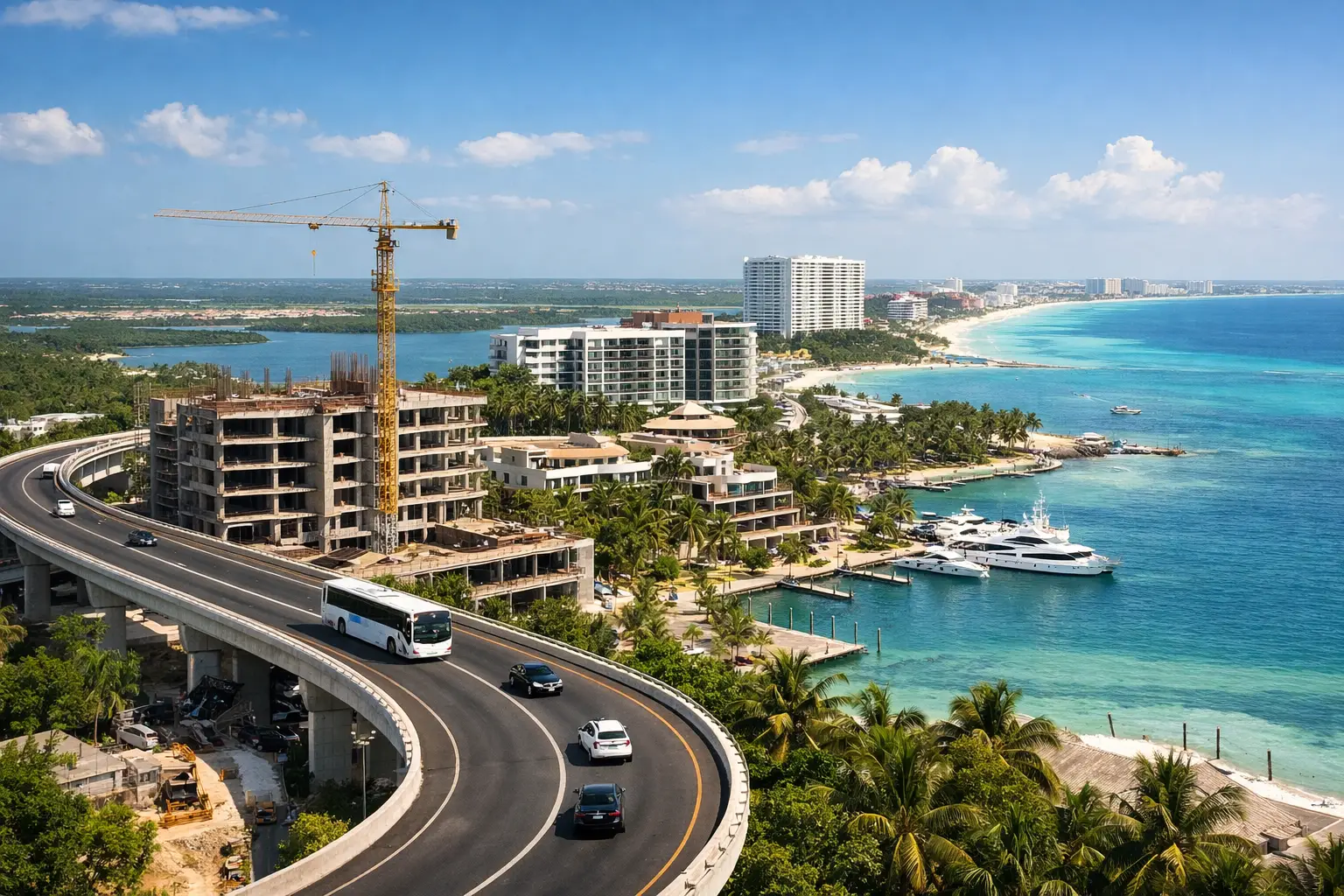
Your condo cannot ride a train, but better transportation can absolutely carry part of its value. Quintana Roo infrastructure growth trends are changing how residents, tourists, and investors move through the state – and that matters when you are evaluating rental demand, resale potential, and the long-term strength of a location.
For American and Canadian buyers accustomed to expensive housing, slow commutes, and limited inventory at home, the Riviera Maya is not simply a lifestyle alternative. It is a region receiving major public and private investment while its tourism base continues to mature. The opportunity is real, but infrastructure alone does not make every project a smart investment. Your job is to distinguish durable demand from a glossy sales presentation.
Why Infrastructure Changes the Investment Conversation
Infrastructure affects real estate through access, reliability, and confidence. A new airport route, road improvement, or rail connection can reduce friction for visitors and residents. That can widen a property’s renter pool, support year-round stays, and make a secondary market more liquid when you eventually sell.
Quintana Roo has a rare combination of international tourism, population growth, and large-scale connectivity projects. Cancun International Airport handled more than 30 million passengers in 2024, making it one of Latin America’s busiest gateways. That volume supports the entire corridor, not just Cancun. Visitors land there, then continue to Puerto Morelos, Playa del Carmen, Tulum, Akumal, and beyond.
The investor takeaway is straightforward: do not only ask, “How close is this condo to the beach?” Ask how easily a future guest, tenant, employee, supplier, or buyer can reach it. Accessibility is part of the asset.
The Major Quintana Roo Infrastructure Growth Trends to Watch
Rail connectivity is reshaping distance
The Tren Maya network spans roughly 1,554 kilometers across southeastern Mexico. In Quintana Roo, its importance is not that every vacationer will abandon a private transfer. Many will not. Its greater value is that it creates another transportation option between airport areas, established tourism centers, and emerging communities.
For investors, this can gradually shift how demand spreads. Places once viewed as too far from major gateways may become more practical for domestic travelers, long-stay visitors, and workers. That said, rail proximity is not automatically positive. A property beside a station may benefit from access, while a property merely advertised as “near the train” could still require an inconvenient drive. Verify the actual route from station to property, not the pin on a brochure.
Tulum airport expands the southern gateway
Tulum’s international airport began operations in late 2023, creating a second major arrival point for the Riviera Maya. This is strategically meaningful for Tulum, Akumal, Bacalar-bound travelers, and the southern portion of Quintana Roo. It can reduce the dependence on Cancun for certain visitor segments and make shorter stays more feasible.
The trade-off is that new air capacity may also encourage more development around Tulum. More flights can mean more demand, but demand attracts supply. A buyer should look closely at the number of planned units in a micro-market, the quality of roads, water systems, and the operating capability of nearby hospitality businesses. Growth works best when supply, services, and demand rise together.
Road, utility, and urban services matter more than headlines
Big projects receive the headlines. Daily infrastructure is what protects an owner’s experience and rental reviews. Road access, drainage, reliable internet, power resilience, water treatment, and waste collection influence whether a property can operate smoothly during high season.
This is particularly relevant for pre-sale condo investing. A lower entry price in an emerging zone can be compelling, but it should come with a more disciplined due diligence process. Confirm the developer’s plans for utility connections, road access, permits, common-area maintenance, and property management. A beautiful rendering cannot compensate for weak execution after delivery.
Where Growth May Matter Most
The Riviera Maya is not one market. Each area responds differently to infrastructure, visitor patterns, and new supply.
| Market | Infrastructure advantage | Investor lens | | — | — | — | | Cancun | Established international airport and urban services | Strong access, deeper resale market, varied rental demand | | Puerto Morelos | Position between Cancun and Playa del Carmen | Lifestyle appeal, but assess neighborhood-level services | | Playa del Carmen | Central location on the corridor and broad year-round activity | Often suited to balanced long-term and vacation rental strategies | | Tulum | New airport and rail-related connectivity | Higher upside potential, with greater supply and execution risk | | Akumal and southern corridor | Improved access to quieter coastal communities | Better for buyers prioritizing lower density and longer holds |
Playa del Carmen often appeals to investors who want demand beyond weekend tourism. Its restaurant, retail, remote-worker, and expat ecosystem can support a more diversified rental strategy. Tulum can offer stronger appreciation potential in selected locations, but it usually requires more patience and closer scrutiny of future competing inventory.
A net rental yield in the 6% to 12% range may be achievable in the right property and operating model, but it is never automatic. Seasonality, furnishing costs, homeowner association fees, management quality, and local competition determine the actual outcome. Underwriting should be conservative enough that your investment still makes sense if occupancy is softer than the marketing deck suggests.
Infrastructure Is Also a Diversification Story
Many foreign buyers are not leaving Canada or the United States. They are reducing concentration in one currency, one tax environment, and one housing market. A Riviera Maya property can add geographic diversification, potential rental income, and an eventual retirement option – provided it fits your larger financial plan.
Mexico’s cost of living can be materially lower than many major North American cities, especially for dining, services, and private healthcare options. Yet lifestyle savings should not be confused with investment returns. Your ownership costs may include trust fees, insurance, HOA assessments, property management, furnishing replacement, and taxes. Compare the full picture, not just the purchase price per square foot.
Foreigners can legally acquire residential property in Mexico’s restricted zone, including coastal Quintana Roo, through a fideicomiso. This bank trust holds title for your benefit and generally provides rights to use, sell, rent, improve, and pass the property to beneficiaries. It is a well-established ownership structure, not a lease. Still, every purchase should be reviewed with an independent notario and qualified cross-border tax advisor.
How to Invest Without Chasing the Loudest Headline
When infrastructure is moving quickly, the biggest risk is buying based on anticipation alone. Focus on the property fundamentals first: usable location, credible developer or seller, legal documentation, construction quality, operating plan, and a realistic exit strategy.
For a pre-sale purchase, ask what has already been completed versus what remains proposed. Review delivery milestones, payment schedules, penalties, warranty terms, and the developer’s completed track record. For a resale unit, examine actual rental statements where available, HOA financials, maintenance history, and restrictions on short-term rentals.
Property management deserves equal attention. A manager who sets rates, responds to guests, maintains the unit, and reports transparently can protect income. A weak manager can turn a high-demand location into an underperforming asset. Ask for fee structure, owner reporting samples, cleaning standards, maintenance response times, and how they handle low-season pricing.
A practical question for your advisory team
Before committing capital, request a scenario analysis that includes conservative, expected, and strong occupancy assumptions. Compare vacation rental income with long-term rental income. Then add all carrying costs. This approach creates financial confidence because you are making a decision from a range of outcomes, not one optimistic number.
FAQ
Is infrastructure growth good for Quintana Roo real estate?
Generally, better connectivity and services can support tourism, residency, and property demand. The benefit depends on the exact location, competing inventory, and whether a project has reliable access and utilities. Infrastructure is a tailwind, not a substitute for sound due diligence.
Does the Tulum airport make Tulum property a guaranteed investment?
No. The airport improves access and strengthens the area’s long-term profile, but Tulum also has significant new condo supply. Your results will depend on product quality, location, management, pricing discipline, and your holding period.
Can Americans and Canadians buy property in Quintana Roo?
Yes. In coastal areas, foreign buyers commonly purchase through a fideicomiso, a bank trust designed for restricted-zone ownership. Work with an experienced notario and cross-border tax professional for advice specific to your situation.
What is the best way to evaluate rental ROI in Playa del Carmen or Tulum?
Use actual comparable rental performance where possible, then model conservative occupancy, nightly rates, management fees, HOA dues, maintenance, insurance, and taxes. Do not rely solely on gross-income projections.
If you are weighing a Riviera Maya purchase against staying concentrated in your home market, take the Investor Readiness Scorecard before you start touring properties. It can help clarify your goals, timeline, risk tolerance, and the type of opportunity that fits your plan.
The market is becoming more connected, more visible, and more competitive. That does not mean you need to rush. It means the strongest window is often before infrastructure becomes ordinary and before well-located inventory is absorbed by buyers who were prepared first.