
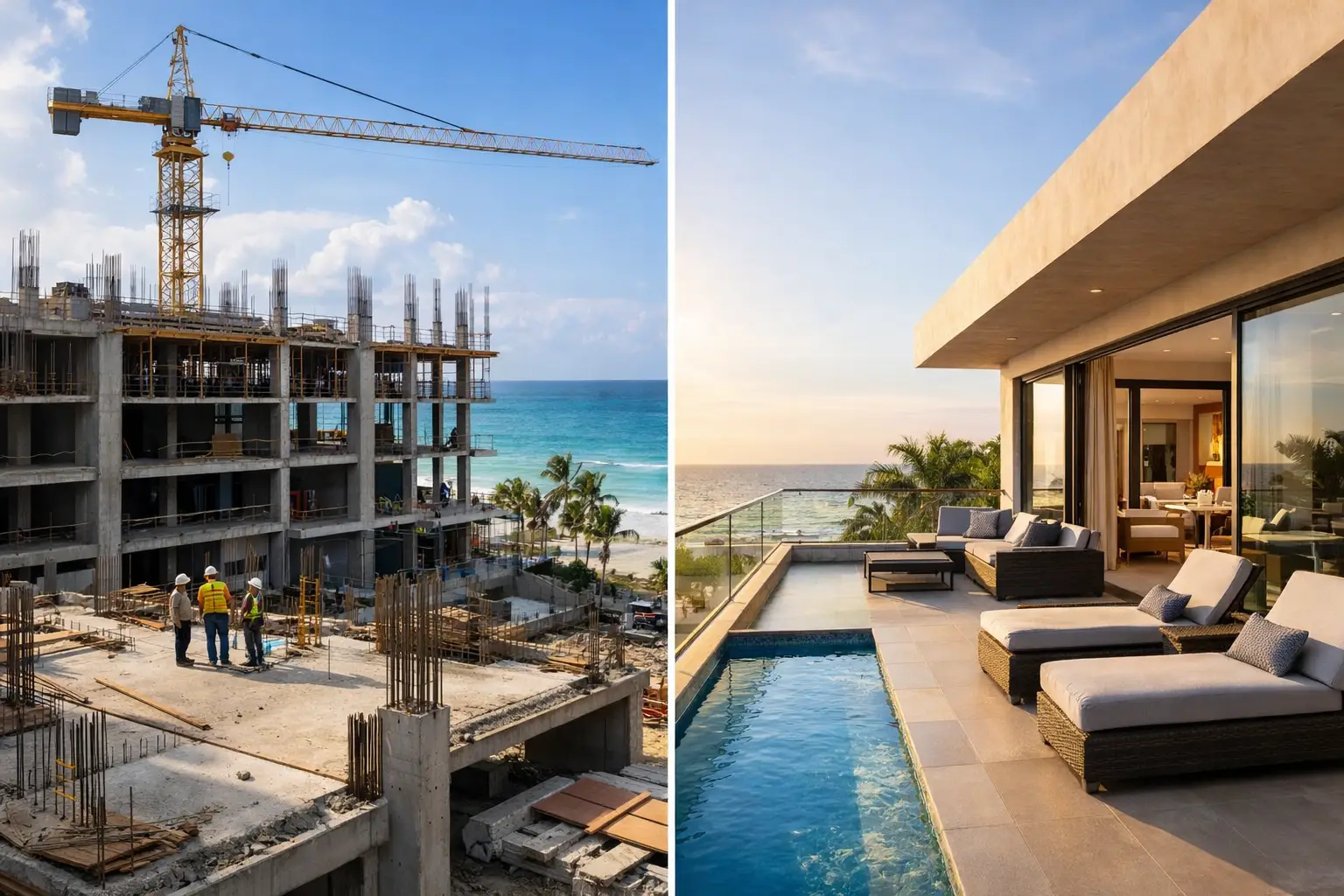
You can fall in love with a rooftop pool in 10 minutes. Cleaning up a bad investment choice takes a lot longer.
That is why the preconstruction vs resale Mexico question matters so much for foreign buyers. If you are buying in Riviera Maya for rental income, retirement, or long-term wealth, the right choice is less about taste and more about timing, risk tolerance, and strategy.
In Quintana Roo, demand has been supported by tourism growth, infrastructure expansion, and continued migration from higher-cost markets like Canada and the U.S. That creates real opportunity, but not every property type works for every investor. A pre-sale condo in Tulum and a resale apartment in Playa del Carmen can both be smart purchases. They just solve different problems.
Preconstruction vs resale Mexico for investors
Preconstruction usually attracts buyers who want appreciation, modern amenities, and a lower entry point. Resale tends to appeal to buyers who want an operating asset, clearer performance history, and less waiting. Neither is automatically better. The better question is what you need your investment to do in the next 12 to 60 months.
If your priority is buying below future market value and letting the market do some of the heavy lifting, preconstruction can make sense. In growth corridors across Riviera Maya, investors often target pre-sale projects because pricing is lower in early phases and payment schedules are more flexible than buying completed inventory.
If your priority is immediate use or immediate rental income, resale has an edge. You can inspect the exact unit, review HOA realities, evaluate the building condition, and in some cases review actual short-term rental performance instead of relying only on projections.
What preconstruction gives you
Preconstruction in Mexico is really a bet on the future of a location, a product, and a developer’s execution. When it works well, it can be powerful. You may secure pricing before full completion, spread payments over the construction period, and benefit from appreciation by delivery. For buyers coming from Toronto, Vancouver, Los Angeles, or Miami, that lower initial basis can feel refreshing.
There is also a product advantage. Newer projects often include features that support vacation rental demand and resale value – furnished packages, coworking areas, wellness amenities, lock-off layouts, and professional rental management structures. In lifestyle-driven markets like Tulum, those details matter.
But preconstruction asks for patience. Your capital is tied up before the unit produces income. Delivery timelines can shift. Finishes, views, or common-area quality may vary from the original marketing. And if you choose the wrong location or weak developer, the discount you thought you were getting can disappear fast.
For many foreign investors, preconstruction works best when you are investing for medium-term appreciation and you are comfortable underwriting the project carefully. That means reviewing permits, trust structure where applicable, construction track record, payment terms, HOA assumptions, and exit strategy. Hope is not a due diligence plan.
Best fit for preconstruction
Preconstruction is usually a stronger fit if you want to build equity during construction, prefer staggered payments, and do not need immediate occupancy or cash flow. It also suits buyers who want newer inventory in high-growth pockets where future infrastructure could lift values over time.
What resale gives you
Resale property is simpler in one major way – what you see is what exists. You are not buying a rendering. You are buying a specific unit in a specific building with a real location, real neighbors, real maintenance patterns, and real operating costs.
That clarity matters, especially for first-time international buyers. You can test commute times, walk the beach access, hear the street noise, inspect the finishes, and compare the asking price to nearby inventory. If the property has rental history, you may be able to review occupancy patterns, average daily rates, and seasonal performance. That makes underwriting less theoretical.
Resale can also work well for retirees and expats who plan to use the unit soon. If you want to spend part of the year in Mexico while earning income the rest of the year, a completed property can shorten the timeline significantly.
The trade-off is that resale often requires more capital upfront. You may also inherit an older design, higher maintenance needs, or a building that no longer competes as well with new inventory. In fast-moving markets, yesterday’s trendy condo can become today’s average listing quicker than owners expect.
Best fit for resale
Resale is often the better fit if you value certainty, want immediate use or rental income, and prefer evaluating actual performance rather than future potential. It can also reduce some development-stage risks that make cautious buyers lose sleep.
The legal and financial side for foreigners
Whether you choose preconstruction or resale, the legal framework matters more than the marketing brochure. Foreign buyers commonly purchase in restricted zones through a fideicomiso, which is a bank trust that allows you to hold beneficial rights to the property. This is standard practice, not a red flag. You should still work with qualified professionals, including a notario and trusted advisors, to review contracts, title history, and closing structure.
Closing costs, annual carrying costs, and tax treatment should be part of your model from day one. Mexico can still compare favorably with Canada and many U.S. markets on acquisition costs and cost of living, but that does not mean every deal is efficient. A property that looks cheap on paper can disappoint once furnishing, HOA fees, management, reserve funds, and vacancy are layered in.
If you are buying for short-term rental use, ask a practical question early: who will manage this when you are not here? The right property management company can affect guest reviews, occupancy, maintenance response, and net returns more than many buyers realize.
Preconstruction vs resale Mexico in Riviera Maya
This is where the local market matters. In Riviera Maya, resale inventory tends to be stronger in established pockets where walkability, beach access, and proven rental demand already exist. Preconstruction tends to be more compelling in expansion zones where infrastructure and new master-planned growth may reshape values over the next several years.
That distinction matters because not all appreciation is equal. Some buyers make money simply by entering early in a growth corridor. Others do better buying a resale asset in a mature area with stable demand and operating it efficiently from day one.
Recent tourism and infrastructure momentum in Quintana Roo has kept investor attention high. Hotel occupancy trends, airport connectivity, and public investment all influence future demand. That does not mean every project will outperform. It means the market rewards selectivity.
A good rule is simple. Buy preconstruction when you have conviction about the submarket’s future and confidence in the project’s execution. Buy resale when you want a clearer picture of today’s value, income, and livability.
So which one should you choose?
If you are a growth-focused investor with a 3 to 7 year horizon, preconstruction may align better with your strategy. If you are a retiree, part-time resident, or conservative buyer who wants an asset you can touch and use now, resale may be the smarter move.
There is also a hybrid path. Some investors start with resale to gain comfort with buying property in Mexico as a foreigner, then add preconstruction once they understand the market better. Others buy preconstruction for appreciation and keep a separate reserve so they are not financially strained during the wait.
Your best move depends on cash flow needs, timeline, and risk profile. Not on what a salesperson says is “hot.”
If you want help sorting through your investor profile before choosing a path, take the Investor Readiness Scorecard. It is a practical way to see whether pre-sale, resale, or a wait-and-watch strategy fits your goals.
FAQ
Is preconstruction in Mexico safe for foreigners?
It can be, if the project is properly vetted. Safety comes from due diligence, contract review, developer track record, and the right legal structure, not from the word preconstruction itself.
Is resale property better for rental income in Mexico?
Sometimes. Resale can be better if the unit already has proven rental demand or can start producing income quickly. Preconstruction may outperform later if bought well in a strong location.
Can foreigners buy beachfront or coastal property in Mexico?
Yes, usually through a fideicomiso in restricted zones. You should consult a notario and qualified tax advisor to understand the exact structure for your purchase.
What has better ROI, Tulum pre-sale or Playa del Carmen resale?
It depends on timing, location, and management. Tulum pre-sale may offer stronger appreciation potential, while Playa del Carmen resale may offer more immediate operating clarity and steadier occupancy patterns.
What is the biggest mistake foreign buyers make?
They buy based on emotion before they understand the numbers. The unit may be beautiful, but if the location, fees, rental model, and exit strategy do not work, beauty gets expensive.
Riviera Maya is still in a window where infrastructure, migration, and lifestyle demand are pushing global attention toward the region. That window will not stay equally wide forever. The buyers who tend to do best are not the fastest. They are the ones who get clear on strategy early, then move with confidence when the right opportunity appears.